Moving the Real World: NC AI and the Future of Physical AI
For years, NC AI has brought worlds that existed only in imagination to life in virtual space. The way a character's joints move naturally, the way light hits a surface and produces fine texture: all of it is the product of years of work to make games and content more enjoyable.
But did you know these technologies are now stepping off the screen? NC AI is taking its first step beyond content AI, which creates the joy of virtual worlds, to become a physical AI company whose technology moves real robots and real industrial sites. This is the story of that journey from the virtual world to the real one.
What Is Physical AI? From Automation to Autonomy
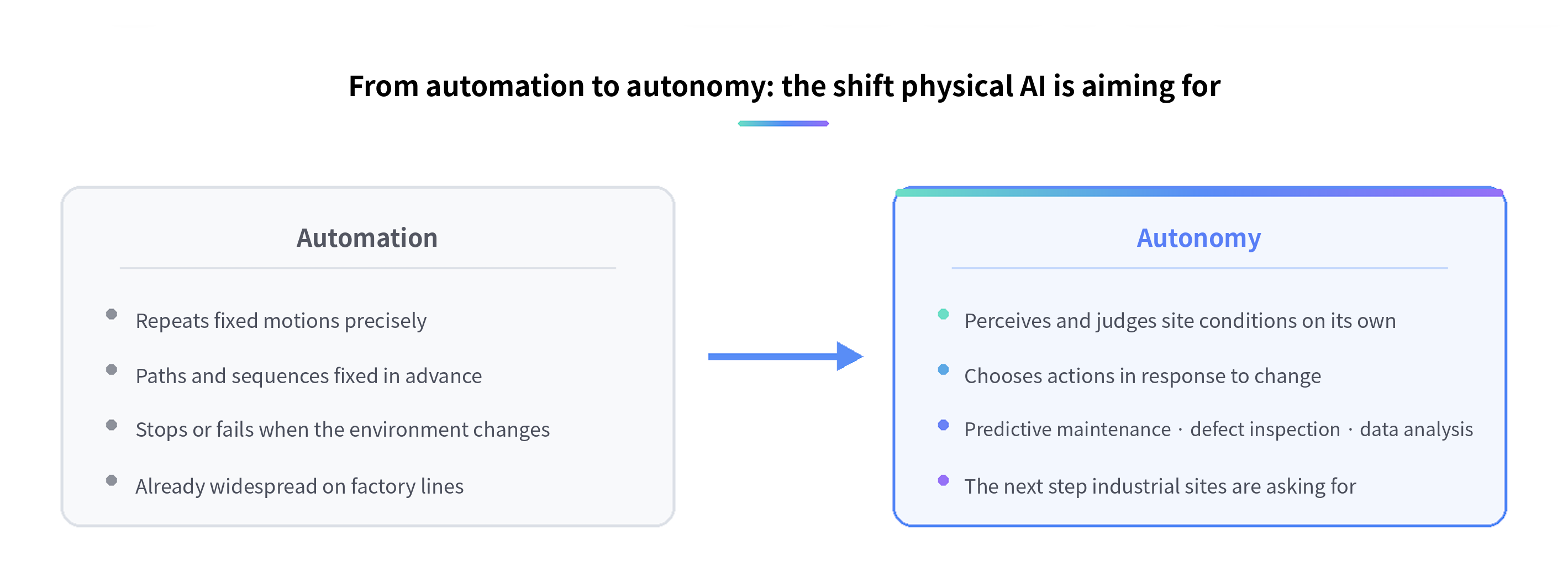
Physical AI refers to AI that does not stop at software computation in digital space. It perceives the real world governed by the laws of physics, reasons about physical cause and effect, and takes tangible action through actuators.
What matters here is that industrial sites are not asking for "robots" as such. Factory lines are already full of automated robots that repeat fixed motions precisely. What sites want is the next step: autonomy, where a robot understands the situation in front of it and makes its own decisions. Tasks that involve judgment, such as predictive maintenance and defect inspection, fall into this category.
One of the key ingredients for that shift is data from which a robot can learn to make decisions, and a virtual training space to generate that data.
The Bottleneck in Robot Learning: Digital Twins and 3D Data
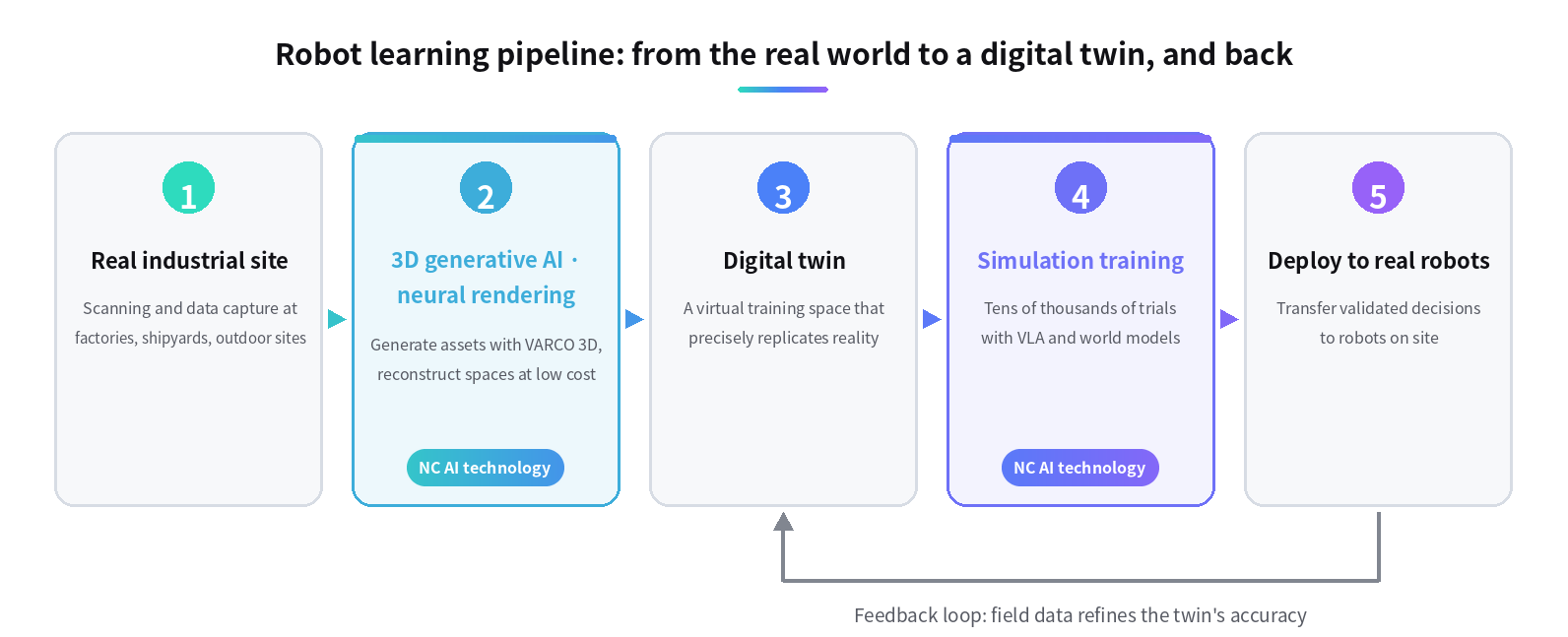
People learn from experience how hard to push a door open. Teaching a robot the same thing is an entirely different problem. Letting a robot practice by trial and error in a real factory or a hazardous site is expensive and dangerous. So robots learn first through tens of thousands of simulations in a virtual space that replicates reality: a digital twin.
The crux is how precisely that virtual space matches reality. If the data is inaccurate, the robot misjudges weight or distance and makes mistakes in the real world. The problem is that the 3D data this requires is far larger than most people imagine. Replicating a single space means modeling or scanning it piece by piece, and that cost and time set the pace of the entire physical AI project.
3D Generative AI and Neural Rendering: Lowering the Cost of Virtual Training Spaces
This is where NC AI's long experience building large-scale virtual worlds pays off. The first thing NC AI is focusing on in physical AI is exactly this: creating the virtual spaces robots learn in, at lower cost and in less time.
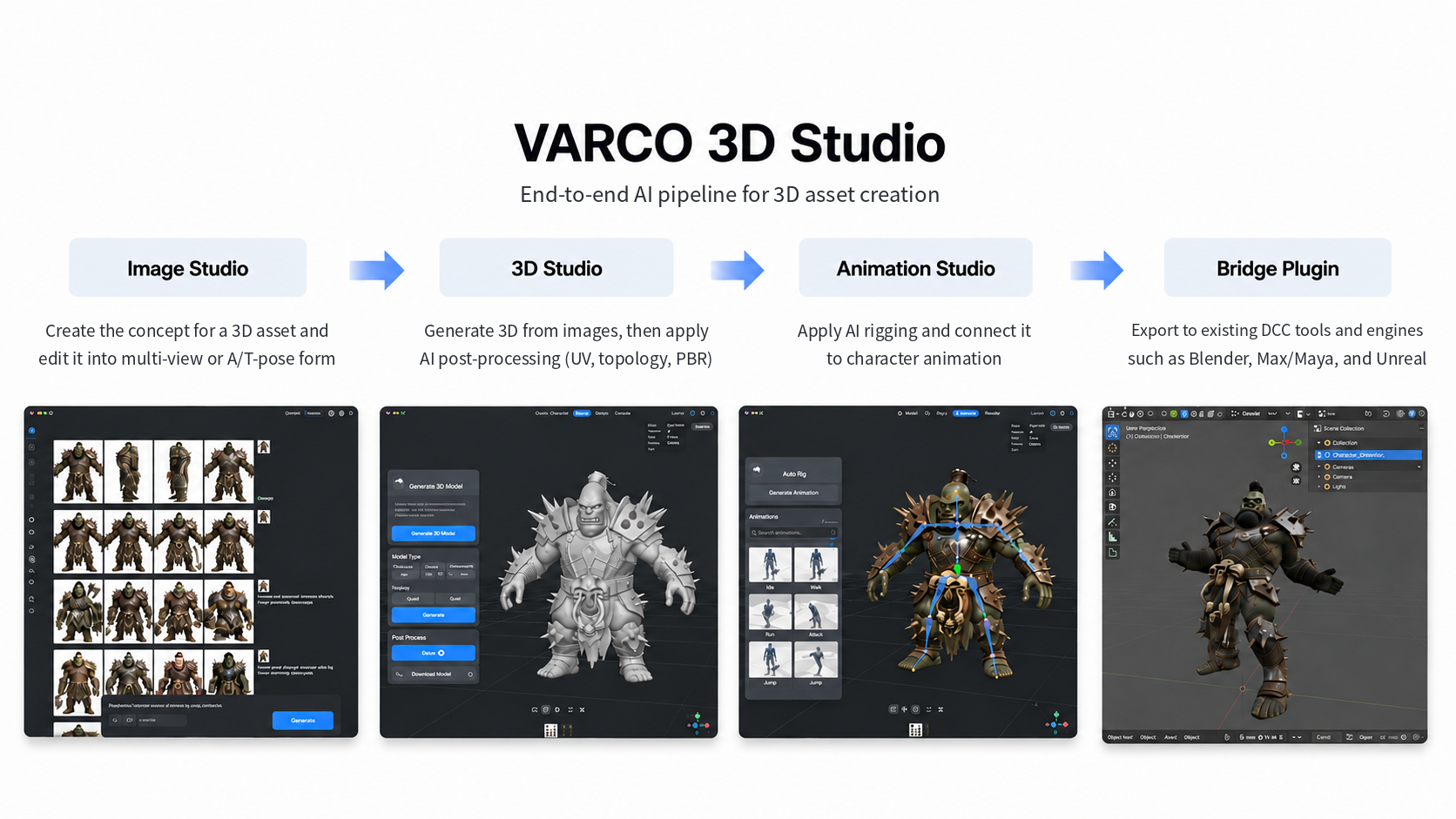
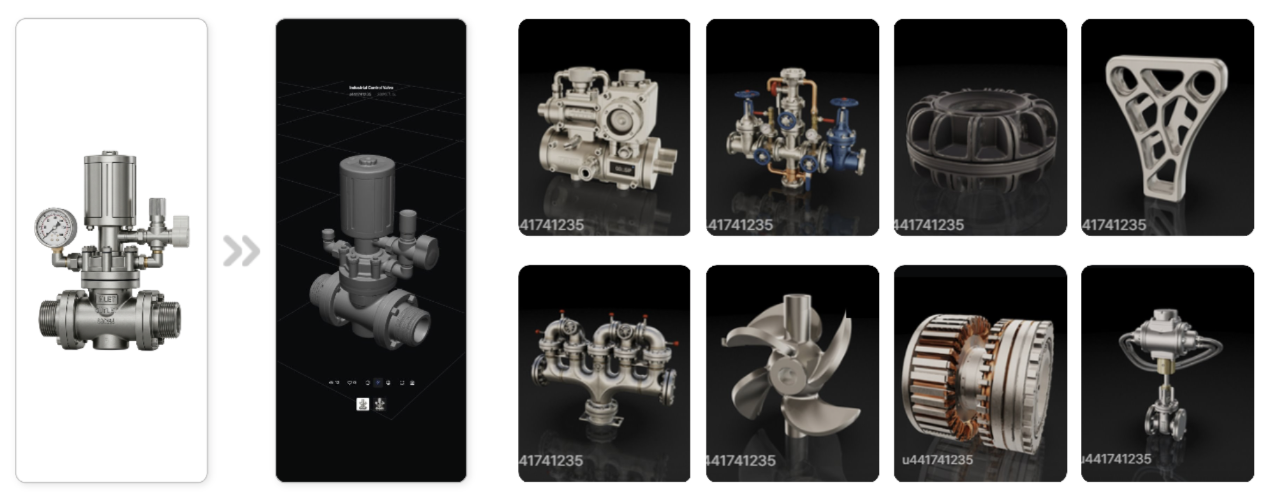
Two technologies work together here. The first is 3D generative AI. NC AI's content AI brand, VARCO, includes VARCO 3D, which creates 3D assets from text and images. It is the only model in Korea that generates 3D assets from text, and version 2.0 reached state-of-the-art-level performance. Anything you load into a simulator ultimately has to be a 3D asset, and this approach uses generative AI to clear that bottleneck.
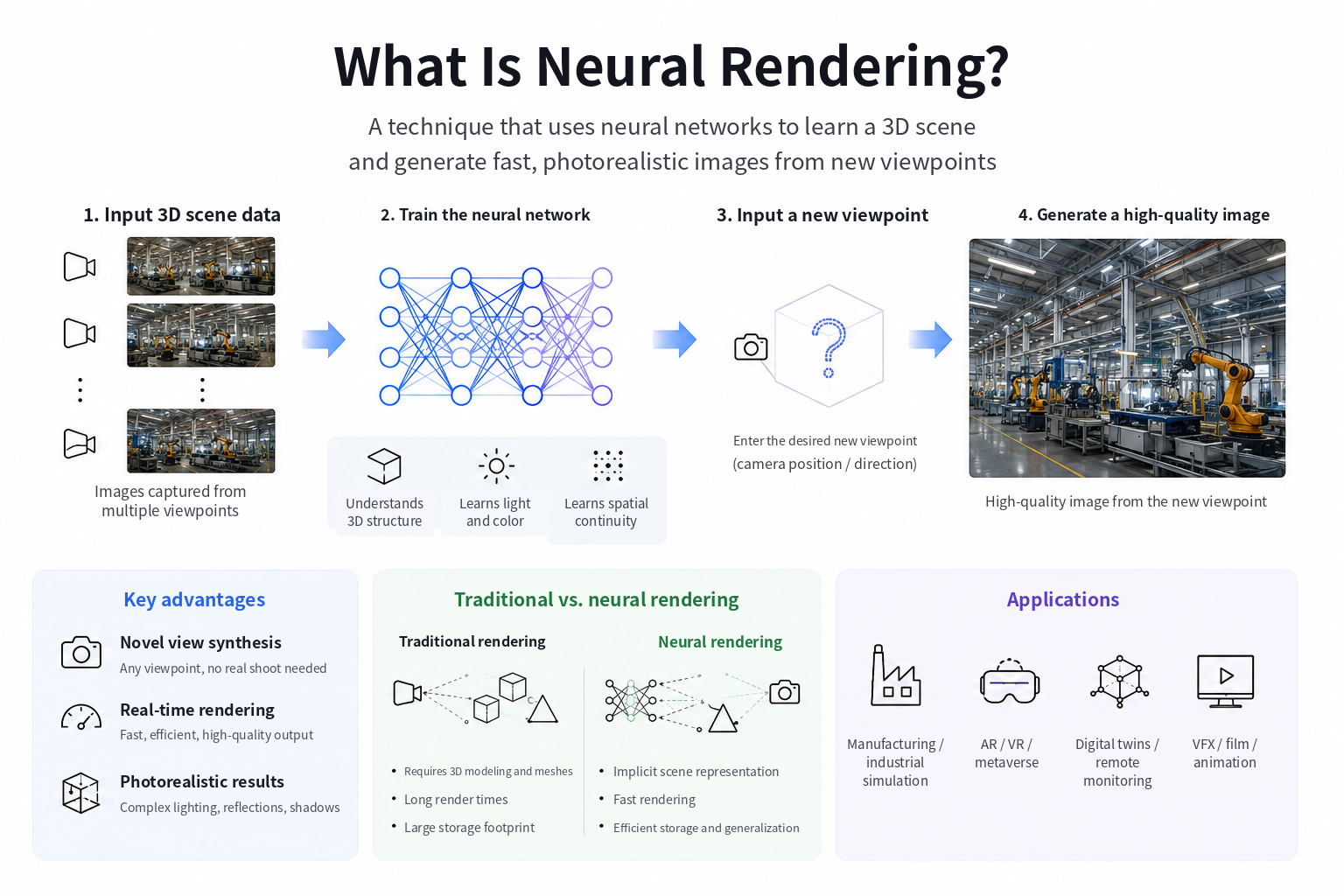
The second is neural rendering, a technique for scanning a specific space and replicating it as a virtual world, an area NC AI refined while building vast in-game worlds. Used together, the two technologies reconstruct real-world spaces at low cost, and that translates directly into more diverse training data for robots.
From LLMs to VLMs, VLAs, and World Models: NC AI's Technology Lineage
Why is a company that started in games talking about robots? The answer lies in NC AI's origins. NC AI grew out of the dedicated AI organization established within NC (formerly NCSOFT) in 2011, the first of its kind at a Korean company, and became an independent company in February 2025. Interestingly, it all began with research on reinforcement-learning-based game AI, which shares the same roots as the way robots learn policies inside simulations today. The team then expanded into natural language processing and released VARCO LLM 1.0, the third LLM in Korea to be developed from scratch, which became the first Korean model listed on Amazon SageMaker JumpStart, earning global technical credibility.
The architecture physical AI requires follows the same lineage: from LLMs to VLMs (vision-language models), and on to VLAs (vision-language-action models) and world models. Agentic AI follows the same pattern of collecting data, training, and turning the result into tools. NC AI has climbed this ladder rung by rung. It has its own LLM and VLM, and is now concentrating on advancing its VLA and world model.
VAETKI, NC AI's Industrial AI: Why Manufacturing and Defense Need Sovereign AI
NC AI's industrial AI brand is VAETKI. The name stands for "Vertical AI Engine for Transformation of Key Industries," and it is a multimodal platform focused on industry-specific AI rather than general-purpose AI. Why vertical?
First, every industry has terminology and data that only make sense within it. Whether it is an agent or a VLM, the model has to understand and produce that language before real AI transformation (AX) can happen. Second, much of what happens on site exists only as tacit knowledge in people's heads, and in many cases digital transformation (DX) is not yet complete, let alone AX. Third, manufacturing and defense are cautious about adopting foreign models because of security concerns. Being able to supply an in-house foundation model, in other words sovereign AI capability, becomes a condition of entry. Along these lines, NC AI has been winning a series of government-funded programs and real deployment projects built on VAETKI and VARCO, proving itself in practice.
Manufacturing, Shipbuilding, Defense: Building Physical AI References on Site
NC AI's current partners include POSCO DX, Hanwha Ocean, and Hyundai Rotem, spanning manufacturing, shipbuilding, and defense, the backbone of Korean industry. On the agent side, NC AI also works with manufacturers to build the agents and ontologies they need.
Hyundai Rotem (defense): In a large-scale project to build a digital-twin-based simulator and modular hardware that integrate control of multiple types of unmanned robots on the future battlefield while minimizing the gap between real and virtual environments, NC AI leads development of the world model that serves as the robots' brain.
POSCO DX (manufacturing): Co-developing a robot foundation model that lets robots understand, judge, and act on complex factory-floor situations on their own.
Hanwha Ocean (shipbuilding): In autonomous welding, where intense arc light and fumes make vision AI hard to run, NC AI's industrial vision-language model VAETKI VISION reads the state of the weld target accurately and enables precise robot motion.
From Virtual Characters to the Brains That Move the Real World
The technology NC AI once used to breathe life into virtual characters on screen is evolving into the brains of robots that keep people safe and drive industry forward. With proven 3D technology, strong industry partnerships, and a collaboration network that spans Korea's leading companies and national programs, NC AI is writing the next chapter of physical AI. Stay tuned.