LEAP 2026 on the Ground: AI's Next Step, from Generative to Physical AI
NC AI was in Riyadh, Saudi Arabia, for LEAP 2026 from August 31 to September 3. We exhibited at the Korea Full-Stack AI Pavilion as part of a program that validates vertical AI services running on Korean-made AI chips. It was a massive event: more than 200,000 visitors over four days and over $15 billion in investments and partnerships announced. But what struck us most was something you could see just by walking the halls: AI is stepping off the screen, moving from LLMs and agents to digital twins and robots.
In this post, we look at the global AI trends we saw at LEAP 2026, how the competitive landscape of physical AI is shifting, and what teams evaluating digital twins or physical AI should keep in mind.
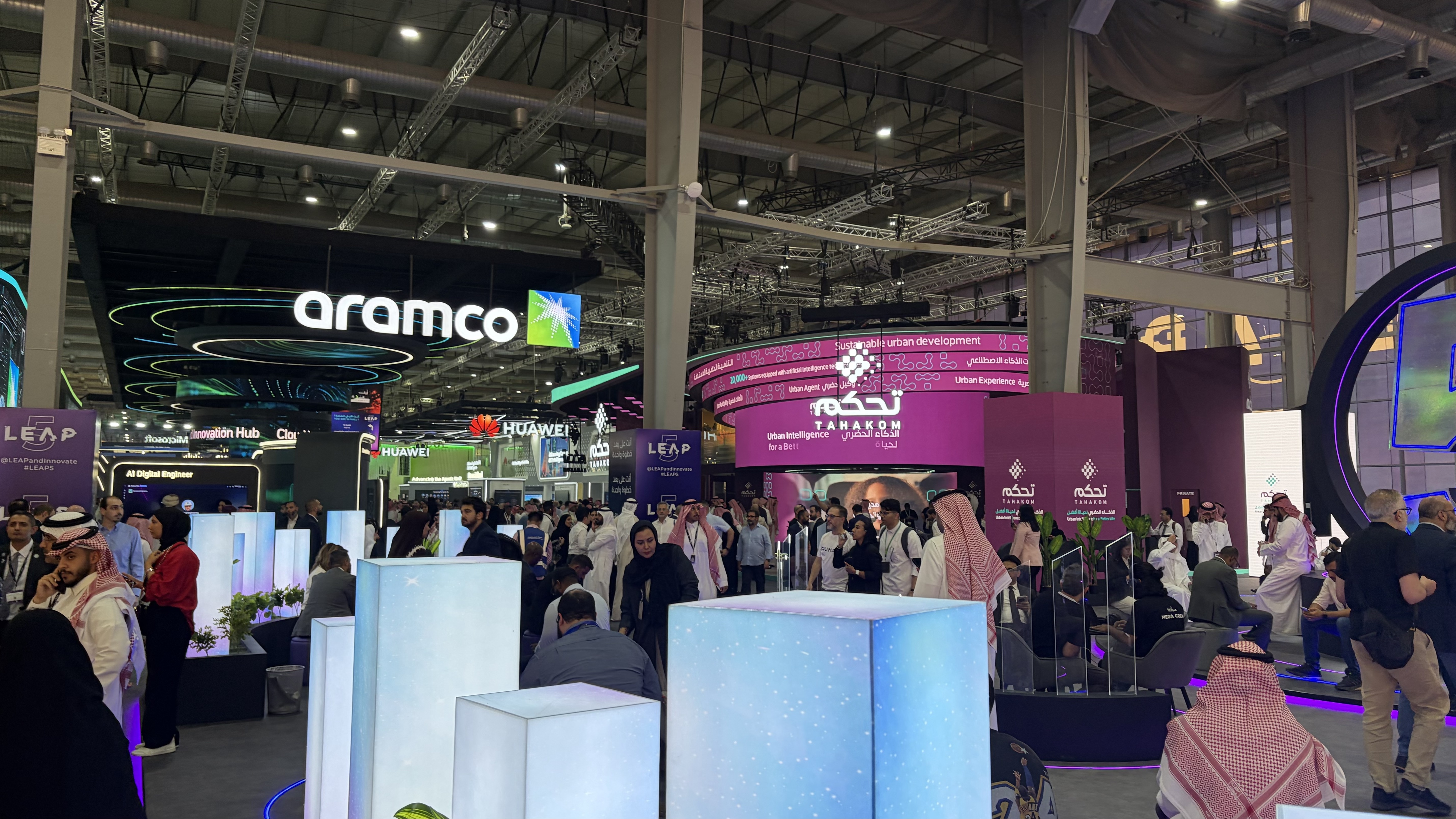
LEAP 2026: The Whole AI Stack, Laid Out by 72 Countries
LEAP is a major technology exhibition and conference organized by Saudi Arabia's Ministry of Communications and Information Technology (MCIT) and its partners, now in its fifth edition. With Saudi Arabia designating 2026 its "Year of AI," the announcements leaned heavily toward AI infrastructure. From hyperscalers (AWS, Microsoft) and chipmakers (AMD, NVIDIA, Qualcomm) to robotics companies (Unitree, AGIBOT) and national pavilions like Korea's, exhibitors from 72 countries laid out the entire stack, from infrastructure to robots, in one place.
Each hall had its own theme, but walking the five halls in order revealed a single throughline: AI that used to run on screens is being deployed into the physical world.
What we saw, hall by hall
Hall | Focus | What we observed |
|---|---|---|
Hall 1 | Enterprise AI / Digital Twin | Digital twins moving beyond 3D visualization into operational DTs that connect equipment, sensor, and workflow data |
Hall 2 | AI Platform / Agent | Agentic AI and AI platforms that plug foundation models into enterprise workflows, ERP, and legacy systems |
Hall 3 | Industry-Specific AI / Robotics | Robots, industrial IoT, smart factories. The dominant pattern: sensors → DT → AI → prediction and control |
Hall 4 | Smart City / Edge AI | Smart infrastructure built on 5G, edge, and IoT, with many examples combining AI with city, energy, and industrial facilities |
Hall 5 | DeepFest / Physical AI | The most direct physical AI showcase: humanoids, embodied AI, robot foundation models. The real race is for robot data and foundation models |
Three Takeaways from LEAP 2026
1. AI's reach is extending into the physical world
LLMs → agents → digital twins → robots and physical systems. This sequence reflects both how the technology has matured and the order in which companies have adopted AI. Companies that have used generative AI for documents and code are now asking the next question: "Can this work on our equipment and our shop floor?" The LEAP 2026 halls were full of companies trying to answer it.
2. Digital twins are shifting from "something to look at" to AI's context layer
The clearest change was in the role of the digital twin. Where a digital twin used to be a way to show reality, it is now being used as the context layer that AI relies on to understand reality and make decisions.
For an agent or a robot to make decisions on site, it needs a machine-readable picture of the current state of the world. When equipment locations, sensor readings, work sequences, and logistics flows are structured in a single virtual space, AI can understand the situation, simulate its options, and predict outcomes on top of it. The digital twin stops being a visualization tool and becomes the basis for AI's judgment.
There is a practical bottleneck, though: building the twin itself takes a long time. In older plants, equipment information often survives only as 2D drawings, and turning them into 3D assets is still largely manual work. If you already have a twin, that asset is your starting point for physical AI. If you don't, the question becomes how to build one quickly.
3. In physical AI, the edge comes from connecting data, simulation, models, and control, not from hardware
The competitive landscape of physical AI on the show floor was clear. What separates the leaders is not the robot hardware itself but how much robot data, simulation/DT, AI models, and robot skills they have secured, and how well they have connected them.
Even with the same robot, results differ depending on which field data you use, in which virtual environment you train, which model you train, and which task skills you end up with. That is why physical AI is no longer a contest of single technologies but of the full stack: an integrated pipeline from digital twin to simulation and world models, to VLA and robot foundation models, to robot and equipment agents.
NC AI at the Korea Full-Stack AI Pavilion
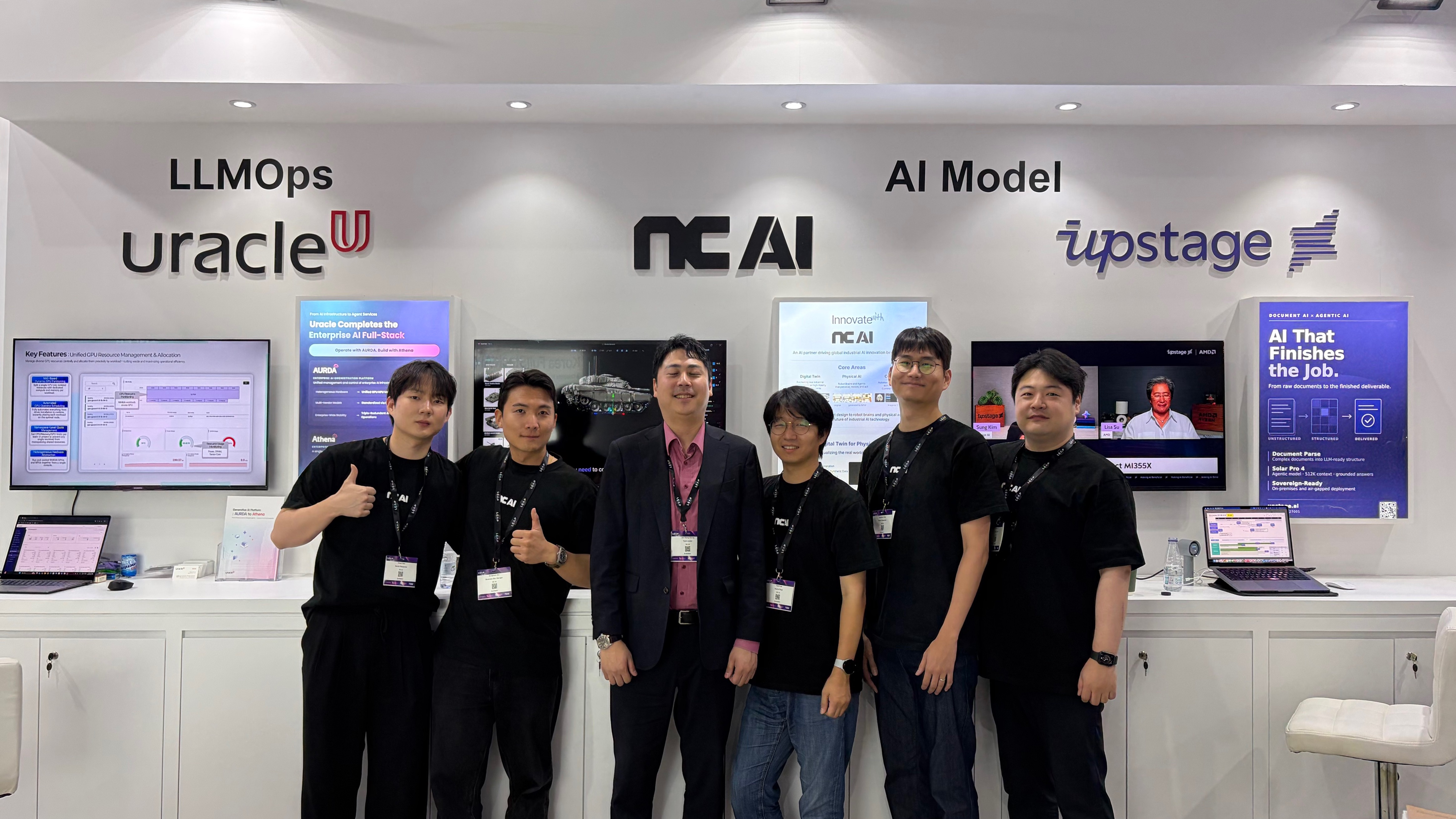
At the Korea Full-Stack AI Pavilion, NC AI presented the physical AI architecture behind VAETKI, our Industry-Specific AI. It links three layers into one: a digital twin that reconstructs the physical space, a world model that understands the physical world, and a robot foundation model that decides how the robot acts. We also ran demos built with VARCO 3D, our 3D generative AI, and VAETKI Twin, our digital twin platform.
Visitors could walk through 3D virtual environments of an animated logistics center digital twin, an urban district with its streets and buildings, and the LEAP 2026 venue itself, including the Korea pavilion. NC AI will keep validating physical AI in real industrial settings, as one continuous flow from digital twin to robot learning to on-site execution.
